Pages

June 28, 2011

renewed interest...

About a year ago I abandoned my Korean lessons. There were several reasons for me to lose interest in those studies. I think that a very large reason was my inability to understand what the fuck was going on. The 'easy' Korean alphabet regularly confused me. I was actually absent the day my they went over the characters. Instead I caught them all as a review and even then I think the process was flawed, one class for the entire alphabet? I was in an introduction course and they spent a tiny percentage on the basics of the Korean language. My entire class appeared to suffer as a result. Yet I still went week after week.


There were two other reasons that caused me to ditch the language. First, my then girlfriend had and aptitude for languages. I wouldn't put it past her abilities to learn the basics on basically every language on the planet. She was great with accents, and with Korean that is a major hurdle to overcome. She was able to correctly pronounce the subtle variations in the language. I was also more than willing to stand idly by and let her do the legwork (involving basically every daily interaction I had with Koreans).

My final reason was simply my own fault. I think that I was grasping onto English too much during the whole process. It's a mistake that I feel that I made in hindsight. When I used to write down all the new words and characters I would constantly write the phonetics below the word. It led to me only recognize the English phonetics below the Hangul text. I was never able to create a mental connection between the sounds coming out of my mouth and the elegant Korean Hangul text. The longer I participated in this act, the more and more frustrated I became with the language. I felt overwhelmed, and when that happened I gave up on the language. Coupled with the previous two elements it was too easy to give up.

Since I've had to face the Korean world alone, things have been different. I resigned up for introduction classes three months ago, and this attempt was successful. I can now read pretty much any Korean word. I do have problems when it comes to large words, but no more than any child would. Menus are now an interesting world for me, half filled with things I know, and the other half things that confuse me. I tell my students that I can read Korean and they freak out. They quickly scribble down anything they can, it's then that I tell them that just because I can read doesn't mean that I know what it means. Much like new vocabulary for them, they can read it, but that doesn't mean shit when it comes to comprehending it.

Armed with my basic vocabulary, I find myself attempting to utilize it at every turn. My major problem is that my vocabulary is so basic that it's basically unusable in the 'real' world. While that is partially a lie, knowing what some fruits are called is really helpful. I find it hard to introduce those words into my daily life, and much like I've learned through teaching my students. Repetition is the key, and if I don't keep repeating휴대전화I'll forget that most Koreans simply call it a한드 폰 (phonetic: Handepon, Konglish for cell phone).

I recently graduated from my first level class this past weekend. I was pretty excited, and impressed that I could achieve this small goal. Especially less than a year after I abandoned it, I now have a feeling of independence. I've made the further commitment to take the second level of Korean lessons. I think this continued education is exciting, especially as it moves me closer to having proper conversations with people in my adopted country.

June 20, 2011

hearts, hills and the House...

It seems like every time that I need an escape from Seoul I head to Sokcho. I can't fully explain my love affair with this town. I believe that there is a mix of a lot of different elements. I definitely think that it has something to do with its distance. It is far enough away that I can mentally check out on the bus ride there. Once I step off the bus I feel refreshed, like a new person.


This past trip was my third expedition to the city, and I was hoping for it to be my most ambitious one. My hopes were quickly quashed by a lack of sleep. Life has been stressful of late, and sleeping hasn't been the most enjoyable pastime. It was my original goal to hike Ulsanbowi shortly after arriving in Sokcho. In fact I even dreamed about the hike while I was sleeping on the beach. The beach was as it turns out was exactly what I needed. I made myself a lounger in the sand, and watched as my friends frolicked in the sand and water.

Later that evening, and just like my previous visits to Sokcho, included fireworks. The fireworks aren't necessarily cheap there, but that isn't really the point. The best part is the fact that you simply can use them. Procuring and holding a package of 20 roman candles, is worth much more than the corresponding price. Especially when you watch other people launch them from their fingertips. A note for those who follow my previous posts about Sokcho, no I did not hump any fireworks into the ocean. I was a semi responsible adult and did not launch from the hip. Yet, I wasn't fully responsible and launch them from the sand.

My overall feelings of laziness did not improve on the second morning. The dogs outside decided to forget they were canines and instead think they were chickens. They barked as a rooster would crow at the invading sunlight. I laid on the floor of the hostel room and pondered, why me? why do I drink so much soju? it does nothing for me, but enlarge my waistline.

While I was eating breakfast the owner of the Hostel, Hyu-Jun, approached me, and without hesitation he welcomed me back. His genuine and thoughtful approach is something that I've come to expect from this hostel. I first visited it back in September, and to be honest I'm not that surprised he recognized me. Hyu-Jun runs a great operation, and is one of the kindest Koreans I've ever met.

The House is exactly what a Hostel should be. It doesn't seem to fit in the Korean landscape though, it would fit much better alongside other hostels in Europe. It has all the amenities, conveniences and charm you'd expect from a hostel, down to a shelf of battered DVDs beside a communal television. The walls are decorated with postcards of praise from prior patrons, and bookcases filled with random trinkets. I easily recommend this hostel to anyone staying in Sokcho (you can visit its website here).


I've never had two days of sunshine in Sokcho, there is usually at least one day ruined by rain. I was told that my last day had an 80% chance of rain, but scoffed at that report as I stared into a hazy blue sky. We made our way up to Seoraksan National Park late in the morning. I was fully aware that I wouldn't be climbing Ulsanbowi, but I was happy and excited that I'd get a great opportunity to play around with my camera.

I got my best photos after a short cable car ride and 5 minute hike. It took me to the peak of one of the mountains. The last time I ventured up to this peak I couldn't step foot off the path, water was flowing like a river down the slippery rocks, and my knee was only about 25% healed. The lack of rain helped, as I scoured the rocks. The park staff has done a great job in making the hike up to the summit safe, but once you are at the top you are free to do as you please. I find it shocking that people are allowed to freely climb these rocks, one false step will lead to death as you'd be tumbling down the mountain.
 
There will be another return to Sokcho sometime in the future. I heard whispers about the fall, but I doubt I'll last that long without making my way back. There is something about the town that keeps calling me back. Perhaps it's the goodbyes I get. It always seems to rain whenever I'm leaving Sokcho. I suppose it is the coastal town's way of saying goodbye, with buckets of tears.

June 05, 2011

white out warzone.. aftermath

As is the case with most battles there is a fallout, some kind of repercussion, or consequence. Believe it or not, the tests my students take have a relatively quick and devastating effect on my classes. My school places a lot of importance upon the class the students are in. For example the MGT1-A1's are the top MGT1 students in the school (there are usually 3-4 classes per grade level).

Much like actual battles, some people shine and are therefore promoted. Others crumble, in combat this means they probably die, and in my school they get demoted. Although a death (of sorts) can occur if a student's test score is bad enough, they can be 'killed off' and sent back to a regular campus. In order to set the war heroes apart from the fallen there is a rubric (how fitting for an educational institute!). The breakdown is as follows:
10% for each of the two monthly exams
30% for a reading comprehension test* (the test measures their American reading level)
50% for a level test*
*Both the reading test, and the level test are not based on material we've covered specifically in class. Instead they are based on material the students haven't seen, and they are tested on the concepts. For example, the reading section of the level test is not based upon any of the stories that we've read in class, while the monthly exams are. The questions for the monthly tests are often questions the students have even seen before, they are taken from the online learning homework. In essence these two tests, which make up the majority of the rubric, are like an actual battlefield as training is truly put to the test. The students will either sink or swim, only their wits can save them
I don't fully agree with this method. I think it is another way that we stress out these already overloaded Korean elementary school students. I currently have three students 'taking a break'. These breaks are often code for 'burned out child'. It creates an ethical dilemma stemming from the immense importance of academics and grades in this culture. This is also a topic I'll focus on for a later post.


Once the tactical performance of each student has been appraised, or marked, the classes are realigned. This past week those results have been released, and 2/3 of the school is on the move. 1/3 of the students have proven that they are tough little troopers and have been promoted. These promotions have come at the cost of student casualties, a 1/3 of the students along with their incorrectly pot marked OMR cards have been demoted. Some promotions are huge, with students climbing two classes, while leapfrogging the tattered corpses of students who fell just as far. The remaining 1/3 have survived the battle and tread water in the same spot they've held prior.

I currently teach twelve classes, and two of them are now comprised of entirely new students. One of those classes is actually filled full of fresh faced new recruits. These students have been brought in an attempt to fill up some of the voids several MIA students have created (students who left during the first three months). Their first week was like a boot camp of sorts, as I was forced to act like a drill Sergeant. These kids entered the battlefield bright eyed and bushy tailed, I sent them home first night shell shocked at the obstacle course I placed in front of them. They've entered right in the middle of concepts (some of which they've never heard of) and routines I've established with all my other classes, I've little option but to put them through the paces.

Surrender is hard for some...
A similar transition is also taking shape in all of my other classes as students from other classes enter my squads (a small military unit). While my school is small all the teachers have their own routines and unique teaching style. Change is never an easy concept to deal with, let alone when you are in grade 1. Any slight change adds stress to the students, which causes them to act unpredictably. I've spent the past week tightening up on my previously loosened discipline.
 
...easy for others.
I've feel that I've been left on the field in the aftermath of this latest war trying to figure out what role each of my students play in my 12 new squads. Some of it appears clear, but three months into the semester this change has mostly added unnecessary stress. With September looming, a countdown has now been set for the next war to take place.

May 29, 2011

cocks and hooters... a tribute to the unordinary...

Traditional museum stereotypes are pretty brutal, and the stereotypes attached to those who frequent them are often as brutal. The words 'boring' and 'pretentious' somehow sneak their way into my subconscious. I don't know where this came from, but for some reason I always expect to meet someone wearing a monocle in a museum.

Thankfully Seoul is filled with bizarre museums as well as the more traditional (which I'm told are amazing, and that I should visit) . A couple of months ago, well I guess a few weeks after I started my current job, my coworkers mentioned an owl and chicken museum. The stories they briefly shared were well worth investigating. Also, just to be clear, these are two separate museums. I'd hate to see these two bird enthusiasts mix.

The 'Seoul Museum of Chicken Art' is a rather strange and misleading name for the cock museum. The museum does not actually feature any pieces of artwork created in any part by a chicken. Instead the building is home to over 2,000 pieces of art about chickens. The entrance fee was meagre, and in case you thought you might get lost in the two story open floor plan, you are sent in with a guide. Well, I kind of feel bad, the guide is not to ensure that you get lost, no, he is there to inform you of all things chicken.

The tour (of sorts) starts at looking at a Korean funeral bier (bier: A stand on which a corpse or a coffin containing a corpse is placed before burial). On one tiny corner of the bier, as pointed out by our guide, is a chicken. Why chickens? because chickens are the only animal with feathers of 12 Chinese zodiac and a messenger between this world and the next (quoted from the guide, and a plaque on the wall). At this point I wasn't sure what to think, I mean it seemed to make sense, although bizarre that a chicken would be responsible for such a task.

The second exhibit further demonstrated the importance of the chicken in Korean culture. According to our guide (and a plaque on the wall) the chicken holds 5 virtues.

 
1. Intelligence: the traditional hat given to government appointed high ranking officials was named after the rooster's crest.
2. Strength: The fierce and sharp talons of the rooster. The guide was sure to point out on the rooster that it's weapon was indeed it's feet, and not it's mouth. Yet, after two years working as a chicken inspector, I'm well aware that roosters prefer to use their mouth when taking on other cocks.
3. Courage: The rooster fights without any fear with its foes. A rooster will always honour it's family and fight to protect them added our guide. This courage also serves as a principle reason why roosters will fight during cock fights. For some reason I now view these fights as domestic disturbances "what did you say about my wife?" " I said she's fat, NOT with a PH!" "OH! NO YOU DITT'ENT!" and apparently when I think of domestic disturbances I think of the ghetto. I'm wrestling with stereotypical inaccuracies right now.
4. Heartedness: the announcing cries the rooster makes when it finds food. Sharing is caring!
5. Trust: The rooster always tells of the morning in whatever circumstances. I consider this annoying, although I can understand how it could be deemed an admirable trait.

With this amazing knowledge in toe, I was shown a bunch of chicken carvings. All ranging from 60-300 years old. I do have to admit that I was really confused about these statues. They were in all different styles, and sizes, although the African cock was not any larger than the Mexican cock, and the Egyptian cock was much more flamboyant than the French one. I have no idea if these wooden chicks were made in homage, or if these Korean cocks were made coincidentally and just happen to look like other cocks (which would help explain my prior sentence). It was shortly after this wall that our guide became distracted and my guest and I were left to our own devices amongst some rather phallic chickens.


                                                                                  Are owls fowl? 

well according to Google, it depends who you choose to believe. I would have to say that the second museum on tap was anything but. While the museum was a lot smaller, and not really a museum at all. The Owl museum stands as more of a collection, an owl obsessed collection. I really wish that I could provide some pictorial evidence of this room, as some of the exhibits were truly fascinating; But photos were not allowed, and my only snaps are not currently residing with me.

I recently gave my children a task of describing a room using all senses except for vision. Although I realize that I can describe it visually without a camera (I've relied too heavily upon my toy lately). I also quickly realize any attempt to describe it with smell and taste would lead you astray, the scent of coffee, and the feel of rough floorboards usually screams kitchen. This museum was a simple one room cabin, complete with wooden support beams and trusses. There were also floor to truss (?) cabinets that most grandparents would store fine china in. Not here though, this Aujima decided to house, and then lock away, owls of all shapes, makes, and sizes.

Much like the chicken museum I was inundated with some knowledge that will be rightfully placed alongside other useless trivia (although no guide was supplied, I had to learn through guessing!). Such as, did you know that there is a hooter on the American dollar bill? Hiding in the top right corner is a tiny owl. This owl symbol is apparently attached to the Iluminati in some way. I didn't waste much time researching this link, I got lazy (but you don't have to be!). There were a couple other shocking discoveries, like the giant snowy hooter on the old Canadian 50 dollar bill, a pink owl Power Ranger, and the owl from 'Sword in the Stone'.

Not shocking, and much to the delight of my students (whom I later told), Harry Potter was well represented. I counted 5-6 different versions, or pictures of Harry's owl. Also not shocking was a Hooters T-shirt hiding in a far corner display. The nicest thing about the owl museum was the complimentary coffee and tea service. I enjoyed the generic tea, and maxim coffee while I was stamping their logo on some paper.


The two museums offered a stark contrast in obsession. The chicken museum took a far more academic approach to the history and importance of the cock. While the owl museum was clearly a collection and obsession taken to an extreme, which is understandable because hooters have become mainstream (especially since Harry Potter). It would be interesting to get the two curators in the same room, I don't know how well the meeting would go. I think that the difference in style would lead to some aggression or confusion. However, I'm sure that both museums benefit from a relatively close proximity to each other. Personally I'd say that the owl museum is probably the true benefactor, at least the cocks have some history and guides within their roost.

May 10, 2011

same same... just korea (pt. ix)

Life is a highway
driving in Korea

I think it's funny that a few weeks ago I was drooling over cars, when I have not driven a car in over a year. Yet there I was, drooling over paintjobs. Even if I had walked out of the convention center with one of those cars I would have been lost, and confused. The streets in Seoul are insane, they are a psychotic playground.
It isn't so much the driver's in Korea that is crazy, it is the system. Don't prematurely expect this to be a rant about Asian drivers. The rules of the road in Korea are different, mostly ignored (because they aren't really enforced), and the roads themselves don't make much sense. Driving in Seoul would be a tricky, tricky thing to do. It's with that in mind that I'd say that the drivers in Seoul are pretty damn decent, It's not their fault that Seoul historically hasn't been set up great for modern driving.

While I'm not intimately familiar with most of the rules of the road. I have noticed one amazing improvement to the NA system. Most intersections (even major ones), there are U-Turn lanes. These crafty lanes are everywhere, and even divided main streets have U-Turn lanes built for them. I love this addition, and it makes cruising around super easy, especially because most vehicles utilize them. I have ridden busses who pulled a U-Turn in the middle of a 6 lane road (it was a part of it's route!).

Although the U-Turn lanes create an interest dilemma, there is no U-Turn flasher on a car. In fact turn signal indicators are rarely used in this city. This leads to the fact that horns are the most important piece of equipment in and Korean vehicle. Being cut-off is a regular occurrence, as is the fact that lanes seem to be a suggestion only. Drivers speed around the roads, swerving, swaying, and fighting for their place on the road. This system creates a highly aggressive yet highly attentive driving force. People drive around with a purpose, and fly across lanes to get where they are going. This is also important because this city wasn't built for driving.

The beautiful grid system that most North American roads are set up with don't really exist in Seoul. However, they aren't anywhere near as windy and ass backwards as some roads I've traveled on in England. Seoul has some amazing motorways, and expressways that have been thoroughly thought out and well planned. They have effectively constructed a whole highway system leaning out over top of the Han river. It is when you come to the side streets that you encounter some issues. The problem is that there isn't really any side streets. They are alleys, wide enough for single lane traffic. This leads to a mess of one way passageways.

This labyrinth is a prime reason why I would credit Korean drivers. They (the alleys, not koreans) are narrow, and often filled with obstructions. Yet, Koreans weave their way around them like nothing. I know that the cars in this country are small, but I would struggle with the precision driving required to pull off some of the turns and quick manoeuvres required here. I would go back to how attentive Korean drivers appear to be as the reason for this. I think in NA we relax too much while we are driving.

The passageway network exists because of housing. Subdivisions in NA are often tricky to navigate, and don't make much sense. Yet at least You can use an address to help you along the way. In Seoul addresses seem to be an afterthought.

Thankfully pretty much every single Korean car that I've been into has a SatNav (or GPS for those unaware of my lingo). These are great little devices, and they really allow you to navigate through the messy side roads. After being a passenger in more than my fair share of taxi's, I've bore witness to some great systems. Some of the new systems come loaded with 3D maps of Seoul! and like most things, they also second as televisions. I've had some great fun watching 3D models fly by, as well as baseball games. I'm usually entertained when I'm in cabs.

Once you are in a car, in my case I'm mostly in taxi's. Directions are super strange in this country. You can't simply get into a cab and give an address. The lack of a grid system, and a reverse address system.

Where do you live?
addresses in Korea

Finding your way around streets in Korea can be a little bit difficult. One of the reasons is that the Korean address system is backwards, well compared to the North American system it is. In North America we start with house # followed by street, then town, province, country. In generic terms you start with the specific house location then work your way out. In Korea the system is reversed. You start with the city, then the neighbourhood, then the building name. I'll write a

North America
Name of recipient
Street Address (room number, for apartments)
City, Province, Country
Postal Code.
Korea
Postal code, city
Ward, neighbourhood, building number
Building name, floor, room number
Name of recipient
As you can see (above) the system is quite different. Another thing that you may also notice is that street name is not included in the Korean example. This is because most of the small streets in Korea are not named. The European system is quite new and not fully used in the country yet. My apartments address has recently been changed, I now have an entirely new address. I got a strange letter in the mail that was later translated to inform me of the change, and I should probably tell me internet company about the change of address, anywho.

The address system in Korea creates problems when you are trying to get around in Seoul. Even though pretty much every car in the city is equipped with a SatNav, they can be useless when it comes to entering addresses into them. When I started my current job, I got into the cab with a co-worker who was giving the driver our school's business card. Normally, and in most western cultures this would work, and the cabby would be on his jolly way. Well the driver did not understand the address. He tried to enter the address numerous times before he gave up, and kicked us out. Because of tricky addresses, it is always best to simply refer to landmarks when traveling.

When driving, and you are unsure of where you are going, people will most often use landmarks to guide them. With the amount of cabs in Seoul, and the sheer size of the city, it is the best way to navigate around. These cab drivers do not possess 'The Knowledge' and are not required to pass any navigational exam, as is required in London, England (confused? read a short blurb about 'the Knowledge'). My situation with the afore mention cabbie would have been avoided if I mentioned two landmarks near my work that most are familiar with. For my journey home, I used the easiest set of landmarks in Seoul, the subway stations. I usually use these when I'm traveling around the city, and I'd advise anyone else to do the same.

I guess, in a nutshell that is my attempt to explain the complex, and chaotic roads in Korea. It really isn't a bleak post apocalyptic world. It just seems about as confusing as one might be. I made a comment the other day, perhaps one that isn't the greatest to admit. If I was really that worried I would probably wear my seatbelt more often in cabs.

May 08, 2011

over your head... and in your face!

 
May 5th is a very important day in Korea. It is Children's Day and no, that is not a made up holiday. It is an actual federal holiday, and everybody has the day off. Parents are supposed to (and most actually do) spend the whole day playing with their kids. 

Before the holiday, I took the oppertunity to play some basketball (May 4th) while playing, I fooled around with my camera. I was toying with my shutter speeds, and I have to admit, I was rather impressed with the results (pictured right, and below).


The following afternoon (Children's day) myself and my coworkers headed out to Hangang Park for the start of the Hi Seoul Festival. This is a bi-annual event in Seoul, I posted a picture of the fall event last year in my year in pictures blog post. 
th
The festival doesn't really take a lot of time to celebrate Korean traditions, it is mostly like a fringe festival. The street performers (pictured above and below) stand testiment to this, they are all decked out in pink attire, and body paint. They also did not speak, they communicated through beeps, yelps and grunts. From what I could tell their goal was to freak people out. They seemed to thrive on shrieks from the crowd, and the Korean's were very willing to oblige. Three performers walked around the crowd (somewhat) normally, one slinked around on stilts (above right), and one crawled around on his hands. If the first four didn't get you to freak out, the guy on his hands would creep up, and shriek. Being the size of a Korean child, he had a great ability to break into people's proximity bubbles without their knowledge.

While I was taking some pictures, the performers got really close. I was not like the Koreans, and I didn't scream, quiver, or run away, even when they tried to smack me (pictured above)

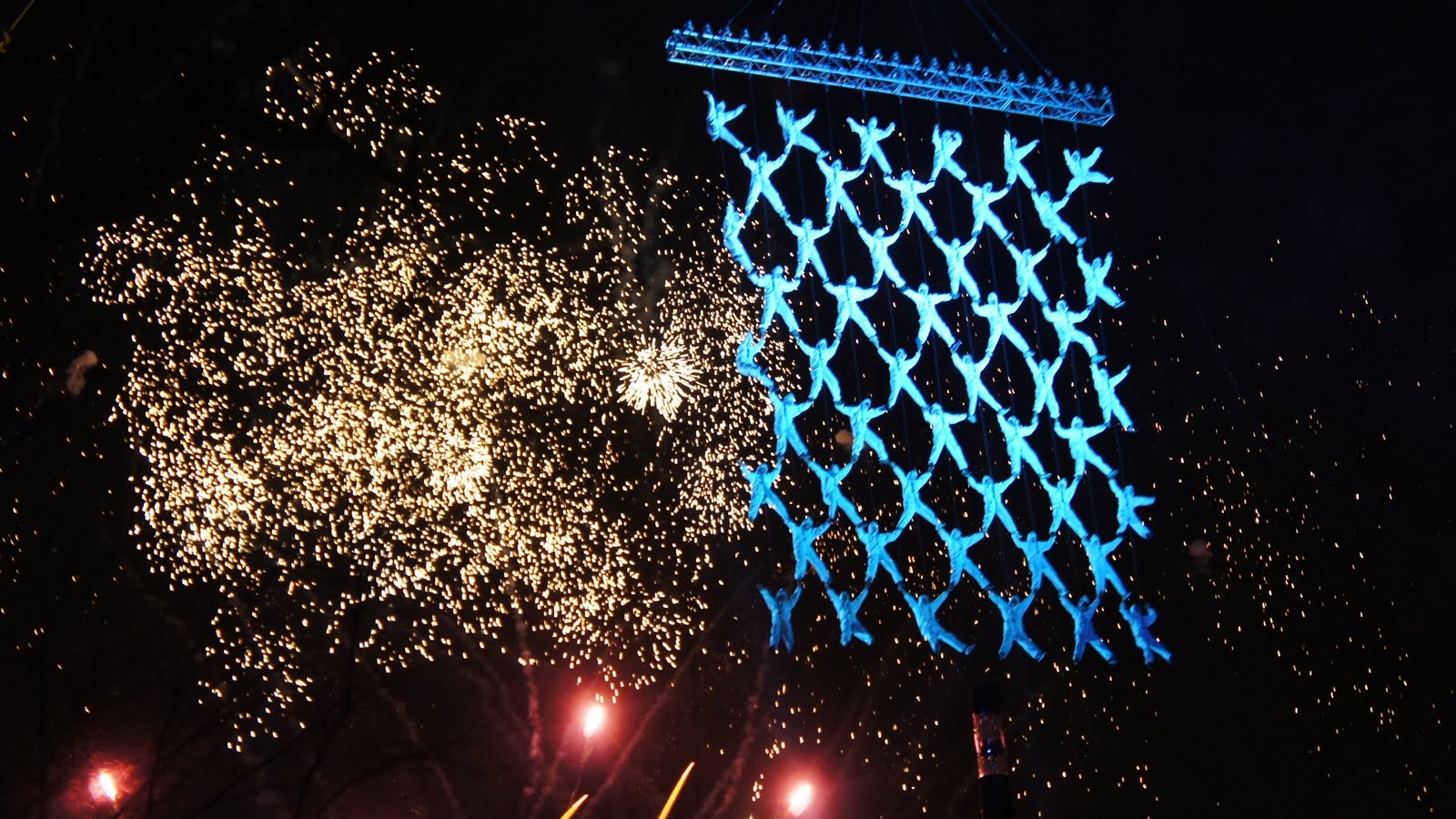
In the evening the festival had a free outdoor performance. The show was called 'Rainbow Drops' and the choreographers are from Spain. I say choreographers because the performers are all Korean. The group recruited a whole bunch of Korean volunteers to perform in their show. The first spectacle in the performance was a giant metal wheel that was suspended above the crowd (pictured below left). Then they put the wheel on the ground and the volunteers/performers (V/Ps, as they will now be lovingly refered to) ran inside the wheel like gerbils, and rolled around, all while surrounded by cheering observers (below right).

 
 The second act, and in my opinion the highlight of the show, was when the V/Ps were strung up and dangled above the audience. At first, it was extremely eerie watching them being raised into the crowd. With my vantage point, behind a tree, it looked like the V/Ps were being hung (pictured below left). They also seemed to play that fact up by looking like ragdolls as the process went on. 


 The performers didn't lay lifeless for their whole stint in the air. They came to life and pulled off some simple manouvers. It was very strange, and impressive to watch them do jumping jacks (right), and throw streamers onto the crowd (above right), all while hanging in mid air.

The grand finale had fireworks launch in behind the performers as they were moved back towards the stage (pictured right, & below). It was an amazing sight to behold as the V/Ps dangled with fireworks erupting and lighting up the night sky behind them. A spectacular end to an interesting holiday. 
(more photos of the can be found on my Flickr page)


May 06, 2011

once is rarely enough...

Last weekend I ventured down to Chuncheon. The trip out of Seoul was Food tourism at its finest, although getting out of the city was a great bonus. Chuncheon is the city in SoKo that is credited for creating my favourite galbi dish DakGalbi. I wrote about this magical mix of chicken, cabbage and spices a short time ago (reread it).

The town is a short 70 minute bus ride outside of Seoul OR if you are into scenic routes, it is a meagre 2 hour subway ride. I elected to take the subway because Sundays are typically a bad day on the roads in any culture (the Sunday driver expression). The subway also offered views that a highway could not (the highways are often flanked by giant walls in Korea), and it was great to see how beautiful the countryside is.

Upon arrival, the foodism (food tourism) instinct took over, and my friends and I scoured the city map in search of Chuncheon's infamous DakGalbi streets. The first treasures the map revealed to our group was not the afore mentioned streets, but paragliding, white water rafting and a shooting range (all creating further reasons to return). It wasn't until a much closer look could we get past adrenaline sports and found the gooey chicken center we were looking for.
Once on the right path, and on the correct street (Myeongdong DakGalbi street) I flashed back to Amsterdam, and the red light district. I found the revelation extremely weird, but I feel that it was because this street existed down a narrow pathway, very similar to some streets in Amsterdam. We arrived around lunchtime and several of the restaurants had line ups out the door, and several had no patrons at all. I knew right away that I'd prefer to wait for a restaurant in demand, than simply sell myself short.
  

We went to the second busiest restaurant on the street, and had to endure a short wait. The Galbi was good, although one thing I immediately noticed was that it was not that spicy. It seemed to be a tame version of what I've enjoyed before. The mild feast was welcomed by a couple in my group who aren't fully up to snuff when it comes to Korean spice. I left the restaurant full, but not blown away.

We went for a short walk/bike ride after our meal in an attempt to work off what we'd just eaten. The town itself was nice, although sold more chainsaws than I've ever seen before. A short list of other attractions: The Virgin Soyanggang; She was a virgin who secretly pined for the affection of a man, not in itself an entirely original concept, but Korea seems to like to build things for virgins who never loved. The penis park in Samcheok boasts a similar origin story. Apparently this statue has a song penned under the same name though, take that penii statues! There was also a bridge that seemed cool at first, it had humps, many humps, humps that would please the black eyed peas. However, what looks cool often fails the test of time. Before I even reached the other side, I felt that the lady lumps were more of a nuisance than anything else.


While we were biking I caught glimpse of a temple on the top of a small hill, and once we finished I made a goal of reaching it. The only problem was that there was no visible pathway. At first we traipsed along the bottom of hill, and our first summit attempt landed us in some Korean vegetable gardens. Our second attempt was fizzled as we thought we saw a path, but then we didn't know if it was a path, then thought it could be a path, but that it probably led back to the vegetable gardens we'd recently explored. Hope came in the form of a dirt trail, with a sign I'm sure read "do not use" but the Hangul was ignored, and the third summit attempt was underway. The path was super steep, yet that didn't falter our group of valiant hikers, and we found our way to the top. Slightly out of breath, the view was even more breathtaking. It was sunset, and the orange glow took a yellow gleam as the yellow dust was out in full force.


Along the route, we managed to meet a backpacker. She had an interesting story, about a month ago she was working, enduring the daily grind, when it was time for a change. She decided to volunteer teach in Cambodia, and booked a flight to Seoul (I'm still somewhat confused about her geography skills, but she wanted to see Korea). Her material possessions now reside in her car in her parents garage. She had already spent a couple days in Seoul, and was working her way down the coast to Samcheok (to see the penis park). We thought it was strange that she arrived in Chuncheon without hearing about DakGalbi (perhaps the allure of virgin monuments??). With that, we thought we should bring her into the fold

Hence the reason for our return to DakGalbi street. It was later in the evening, and the crowds we faced earlier had resided. We went to the busiest place on the street. On our previous visit, this establishment had a long line up out the door. We felt it must be worth it, and my oh my was it ever. This DakGalbi was amongst the best I have ever had. It was a great introduction for our new friend, and it enabled our group to leave Chuncheon full and blown away.