Pages

Showing posts with label same same. Show all posts

October 18, 2011

same same... just korea (pt. xi)

Giving less/Giving nothing
Taxes and tips in Korea 

Taxes have the ability to put many people to sleep, or create a furious debate. I'm fully aware that most of you aren't accountants, and I don't intend to put anyone to sleep. I also don't want to create a debate or infuriate anyone with the low taxes I pay here, so I'm gonna steer clear of that as well.

What I want to focus on is Value Added Tax (VAT).In Canada, and the rest of the world, it is the money that the government makes off of the sales of various products. In Korea that tax isn't added to most products at the till (as is the case in NA/Europe). In Korea the listed price for a product is the price you pay at the register. I am not sure if the tax is sometimes added into the price of a product, but there are places that add it after the fact, confusing? yes.

Anywho, this concept would have been greatly beneficial for me as a child. When I was in middle school I remember straining my mind over the 7% tax that was added to my King Size Snickers bar (1.09 before tax 1.17 after tax). I hated that my enjoyment of the savoury chocolate, peanut and caramel covered nougat was delayed because of math (I was a chubby and lazy so what!). I would have become much chubbier with the sense I saved if I grew up in Seoul. First, the chocolate bar wouldn't be a stupid price ($1.09 what kind of asinine price is that? I hated HiHo Gas and Grocery) and second, I wouldn't have to do math ( I can blame no one here but myself, I got antsy while holding chocolate).

Korea is a different story, in everyday life the VAT is mostly non-existent. I have mostly encountered the tax, when out dining in foreigner friendly areas of the city. Even then, the tax wasn't always charged. It is becoming more and more common due to new government regulation, in 2011 the Korean government started cracking down on interact purchases ensuring the VAT was added. Like many things in Korea there are some ways around the new law. I'm aware of numerous establishments that only charge the VAT on card purchases. Basically giving more support to the cash is king rule.

Living in a society where a tag is god is pretty awesome. Although it creates a situation where when extra charges are added you feel ripped off. I've been told that Koreans often feel this way, and question why they have to pay more than the ticketed price. I think that it's understandable for them to be sceptically. I rarely notice that a VAT has been added and am usually caught off guard when it is. People in this country don't want to pay more than the price on the shelf, it's a learned behaviour and one that's tough to try to implement. Again the only areas of the city I've encountered these charges are in foreigner friendly areas, places where people have dealt with added taxes regularly. This brings about an interesting question though. If the listed price of a product in Korea is the actual price (no added taxes) then were does the standard of tipping get introduced?


Tipping as a practice has been used since the invention of money. It was used in England (and elsewhere in Europe) and spread to its colonies during England's reign as the world superpower. During this time a class structure did exist, and it was seen as customary for people to tip their social inferiors. The concept was frowned upon in the states once they beat the British, and attempted to remove their former employers class based system. However, the working class would swallow their pride, and tipping has since evolved to what it is today, in both N/A and Europe.

The invention, designation and usefulness of tipping was something that has spread through NA/Europe, especially in the restaurant realm. It hasn't been something that caught on very well with other countries. One study by Cornell University proclaimed that minorities with no history of tipping in their culture will tip poorly (ex Mexico) or not at all (ex Asia). In the article Cornell also refers to a tip rate of 15-20% , which confirms I'm also a thrifty guy tipping at around 10%. But their belief that tipping is mostly a Caucasian phenom isn't too far off considering its origins. According to other market research most other ethnicities are also regarded to have poor tip etiquette, while most research ends there, or attempts to get people to divvy up more cash. I'm going to offer a possible Korean explanation.

I'm going to continue to use the food service industry as an example, as it is the area where most people regularly come into contact with tips. In Western culture people can make a living, and sometimes a great one off of the tips they make from a restaurant. I know many who have put themselves through university off the gratuities of others.

For Asia the concept is new, and it becomes a struggle of new ideas clashing with cultural beliefs. During the time that the tip culture was evolving in the rest of the world (hundreds of years ago) most of Asia was practicing isolationism, trading with few countries, and not allowing foreign ideals to ruin their established order. In the past century Korea has been held back from the world stage through its occupation by Japan, followed shortly by a devastating war. Korea has spent most of its time rebuilding itself with little time to focus on cultural revolution. This leads to a disparity, the view that we have toward wait staff in NA / Europe is a different one that is held in Korea.

The current situation in Korea is that you have a society with little value placed on service. Good service is not usually rewarded, therefore not usually provided. Dining in Korea is different because of the lack of service. Your server doesn't do rounds, or spark up idle chit chat. If you need something you hit the Chogi yeo button on the table and a server comes when you need them (I personally like this better, but whatever). The wait staff in Korea seem to be filling a roll more than they are providing a service. There isn't table side bill service, and in many cases (galbi) you are cooking the food yourself. When you give cash for your bill, every cent is returned, and there isn't a doe eyed stare expecting more. If you attempt to leave extra money you are often greeted with question rather than acceptance. "Why won't you take your change?"

The cultural lag is one that is pretty simple, the Korean populous does not like paying more than the stated amount. It's been that way for a long time, and the past 20 years has not seen the widespread introduction of anything different. Did the kings and queens tip their servers years ago? no, it was something that took time to become an established social norm. Korea has spent a lot of time and energy becoming a major global player, and some norms take longer to adopt. Why would there be tips when a role is being fulfilled, instead of a service provided?

This also applies to most other sectors where tips are usually provided. My father was greatly impressed that cabs will return every penny, and even concede some change if the meter barely runs over. He proclaimed to have never experienced that in any city he's ever visited. Again the cabs in Korea are perceived as filling a role, not providing a service. The cabs in the city have undergone some massive changes that somewhat reflect this ideal. Cabbies are now supposed to be paid hourly by their employer, and not on commission from their fares.

(Conclusion)This culture is not used to adding money to a ticketed price, coupled with a service industry that is more simply filling a role than anything else allows for this society to work efficiently without tips. I think once the new generation (the one obsessed with western culture) grows older, there will be adoption of more tipping in the culture. In the time I have been here I have started to see more and more tip jars appear in bars. Not that I've been throwing money inside of them, but they are around, and bound to catch on.

July 22, 2011

same same... just korea (pt. X)

Stay Fashionable

Korea is not a fashion runway like countries such as Italy, but Korea is a country full of people who are dressed great, all the time. The days of the week don't seem to make a difference in the way that Koreans dress. Whether it is the weekday or weekend you are not going to notice a huge variation in terms of dress. It's easily become one of my favourite things about this country. Not like what you'd expect to find in most of North America where people love to dress down when they are not on duty.

Perhaps my favourite part of the whole thing is that they dress the way I'd like to. I've never really been much of a shirt and tie person. Yet recent months and my current work environment have broadened my horizons. I'm at a point where I feel that one should be dressed well, no matter the occasion, or period of time in your life. I spent the 4 years leading up to my Korean experience in University, and my fashion outlook couldn't be any further from where it now resides.


How bout U?

Wandering around the hallways of my U(niversity) rarely resulted in seeing people dressed great. I usually saw a lot of sweatpants and Uof L stitched across girl's asses. Hoodies and sweatpants (later including yoga pants) became the unofficial student dress code. There were usually set times during the course of a semester where'd you could tell it was presentation time, but that was about it.

I loathed waking up for early morning class, and thus often skipped them. BUT when I did attend I would often arrive in my pajama pants. The rest of time I could be spotted wearing jeans and a hoodie (I never really liked sweat pants, although I once found a pair of lululemon pants I did like. They were technically girls pants, it was at a party, and that is another story). The fact that I was a business student didn't mean shit to me. I never wore ties to school, how could I? (I didn't own one: asked and answered) I remember hearing about universities with business casual dress codes, and I remember being appalled. I felt that because I was paying the university, I could dress however the hell I wanted to. Being expected to conform was never one of my strong suits.

Korea couldn't be more different. The attire worn around universities would have made me uneasy only a few years ago. At that point I still rarely wore a collared shirt, and even if I did seldom tucked it in. I always wanted to be comfortable while awkwardly rustling around in my seat. The comfortable look however, doesn't really go over well in Korean universities. I asked a friend about the differences between Universities both here and in the states, she said that she liked how comfortable people dressed in the US, and that there wasn't a certain expectation to dress up all the time. She said that in Korea it doesn't matter if your class starts at 9am or noon. There is an expectation that you are going to show up dressed well.

The women (or girls in several cases) that attended my university rarely dressed up. In fact I'm fairly sure they are the ones who helped implement, and maintain, the unofficial dress code. Ponytails were often the most common hairstyle, and little effort was put into their attire. I didn't viewed it as a bad thing, it never bothered me. Girls would often take their time to get ready for the bars, instead of wasting time for a lecture. It seemed to be for this reason that every club, and the university itself sold tracksuits. Also many guys welcome excuses to check out the walking club adverts.

According to my friend most female Korean U students wear heels, everyday. I think that is pretty much all you need to know to establish the rest of the outfit. Only on 'People of Wal-Mart' would you find people mixing heels with sweatpants. The result is a female populous that is dressed to kill. If the effort put into their hair, makeup and outfits doesn't do you in, being stabbed by their stilettos will.

Just like in western U's fashion is cyclical, and there are times when the fashion changes. Around exam time (presentation time in N/A, when western students dress to impress) Korean's will often study so hard that they slack off in the appearance category. I've been informed that if you show up to school in 'comfortable' clothes, people will ask, and assume that you've had to study hard for an exam. Thus the only excuse a Korean might have to dress down is when the pressure to do well on an exam outweighs the social pressure to dress up.

Pressure U say?

Among the many pressures that face Korean students today, I think at least part of the excellent fashion in this country can be attributed to the pressure to fit in. With this possible explanation group mentality has to be at play here. My friend doesn't know why people dress the way they do at school. She simply proclaims that "everyone does it, so everyone just does it". Although I wonder if students in N/A can truthfully come up with a much different answer.

While the end result is different, and comfort requires a lot less time to prepare for, So N/A students perhaps may have more solid against being collectivist. There is a very real fear of standing out in Korean society, much like any culture who values the group as more important than the individual. I will say this though, I'm very impressed with this group of individuals who are dressed to conquer the world, even if they are only learning about it. The residual effect has created a workforce, and city, that values the way it looks.

May 10, 2011

same same... just korea (pt. ix)

Life is a highway
driving in Korea

I think it's funny that a few weeks ago I was drooling over cars, when I have not driven a car in over a year. Yet there I was, drooling over paintjobs. Even if I had walked out of the convention center with one of those cars I would have been lost, and confused. The streets in Seoul are insane, they are a psychotic playground.
It isn't so much the driver's in Korea that is crazy, it is the system. Don't prematurely expect this to be a rant about Asian drivers. The rules of the road in Korea are different, mostly ignored (because they aren't really enforced), and the roads themselves don't make much sense. Driving in Seoul would be a tricky, tricky thing to do. It's with that in mind that I'd say that the drivers in Seoul are pretty damn decent, It's not their fault that Seoul historically hasn't been set up great for modern driving.

While I'm not intimately familiar with most of the rules of the road. I have noticed one amazing improvement to the NA system. Most intersections (even major ones), there are U-Turn lanes. These crafty lanes are everywhere, and even divided main streets have U-Turn lanes built for them. I love this addition, and it makes cruising around super easy, especially because most vehicles utilize them. I have ridden busses who pulled a U-Turn in the middle of a 6 lane road (it was a part of it's route!).

Although the U-Turn lanes create an interest dilemma, there is no U-Turn flasher on a car. In fact turn signal indicators are rarely used in this city. This leads to the fact that horns are the most important piece of equipment in and Korean vehicle. Being cut-off is a regular occurrence, as is the fact that lanes seem to be a suggestion only. Drivers speed around the roads, swerving, swaying, and fighting for their place on the road. This system creates a highly aggressive yet highly attentive driving force. People drive around with a purpose, and fly across lanes to get where they are going. This is also important because this city wasn't built for driving.

The beautiful grid system that most North American roads are set up with don't really exist in Seoul. However, they aren't anywhere near as windy and ass backwards as some roads I've traveled on in England. Seoul has some amazing motorways, and expressways that have been thoroughly thought out and well planned. They have effectively constructed a whole highway system leaning out over top of the Han river. It is when you come to the side streets that you encounter some issues. The problem is that there isn't really any side streets. They are alleys, wide enough for single lane traffic. This leads to a mess of one way passageways.

This labyrinth is a prime reason why I would credit Korean drivers. They (the alleys, not koreans) are narrow, and often filled with obstructions. Yet, Koreans weave their way around them like nothing. I know that the cars in this country are small, but I would struggle with the precision driving required to pull off some of the turns and quick manoeuvres required here. I would go back to how attentive Korean drivers appear to be as the reason for this. I think in NA we relax too much while we are driving.

The passageway network exists because of housing. Subdivisions in NA are often tricky to navigate, and don't make much sense. Yet at least You can use an address to help you along the way. In Seoul addresses seem to be an afterthought.

Thankfully pretty much every single Korean car that I've been into has a SatNav (or GPS for those unaware of my lingo). These are great little devices, and they really allow you to navigate through the messy side roads. After being a passenger in more than my fair share of taxi's, I've bore witness to some great systems. Some of the new systems come loaded with 3D maps of Seoul! and like most things, they also second as televisions. I've had some great fun watching 3D models fly by, as well as baseball games. I'm usually entertained when I'm in cabs.

Once you are in a car, in my case I'm mostly in taxi's. Directions are super strange in this country. You can't simply get into a cab and give an address. The lack of a grid system, and a reverse address system.

Where do you live?
addresses in Korea

Finding your way around streets in Korea can be a little bit difficult. One of the reasons is that the Korean address system is backwards, well compared to the North American system it is. In North America we start with house # followed by street, then town, province, country. In generic terms you start with the specific house location then work your way out. In Korea the system is reversed. You start with the city, then the neighbourhood, then the building name. I'll write a

North America
Name of recipient
Street Address (room number, for apartments)
City, Province, Country
Postal Code.
Korea
Postal code, city
Ward, neighbourhood, building number
Building name, floor, room number
Name of recipient
As you can see (above) the system is quite different. Another thing that you may also notice is that street name is not included in the Korean example. This is because most of the small streets in Korea are not named. The European system is quite new and not fully used in the country yet. My apartments address has recently been changed, I now have an entirely new address. I got a strange letter in the mail that was later translated to inform me of the change, and I should probably tell me internet company about the change of address, anywho.

The address system in Korea creates problems when you are trying to get around in Seoul. Even though pretty much every car in the city is equipped with a SatNav, they can be useless when it comes to entering addresses into them. When I started my current job, I got into the cab with a co-worker who was giving the driver our school's business card. Normally, and in most western cultures this would work, and the cabby would be on his jolly way. Well the driver did not understand the address. He tried to enter the address numerous times before he gave up, and kicked us out. Because of tricky addresses, it is always best to simply refer to landmarks when traveling.

When driving, and you are unsure of where you are going, people will most often use landmarks to guide them. With the amount of cabs in Seoul, and the sheer size of the city, it is the best way to navigate around. These cab drivers do not possess 'The Knowledge' and are not required to pass any navigational exam, as is required in London, England (confused? read a short blurb about 'the Knowledge'). My situation with the afore mention cabbie would have been avoided if I mentioned two landmarks near my work that most are familiar with. For my journey home, I used the easiest set of landmarks in Seoul, the subway stations. I usually use these when I'm traveling around the city, and I'd advise anyone else to do the same.

I guess, in a nutshell that is my attempt to explain the complex, and chaotic roads in Korea. It really isn't a bleak post apocalyptic world. It just seems about as confusing as one might be. I made a comment the other day, perhaps one that isn't the greatest to admit. If I was really that worried I would probably wear my seatbelt more often in cabs.

April 13, 2011

same same.. just korea (pt. viii)

Turnover

Turnover is a trend that exists in all industries, and all facets of life. The lifecycle can even be viewed as turnover, it's a very generic term. However I'm going to apply it in two ways that directly relate to my experience in Korea.

I have played part in a major event in hagwons, The turnover of staff. February is the single largest time for staff turnover in the country, more teaching positions open up in February than any other month (next is September, and there are other random times peppered throughout the year). The biggest reason is because the school year starts in February in Korea, and it is the easiest time for there to be a switch in schools. Many teachers leave positions to find new jobs, (I'd be included here) or leave the country and start another adventure. I find it sad to have to say goodbye to those I've actually gotten along with, mostly aware that we probably won't cross paths again. Yet, that is Korea, it's like a wild washing machine, we are all thrown in, spun for a cycle (a job as an english teacher can be as strange, if not stranger than most) and then discarded at random times, to random places around the world.
 
One of my co-workers told me that working in Korea is like triple time. Because there are no lines between work and play. Being a friend with a person in Korea for even one year, is like being friends with them for three years in the real world. I would have to agree with that statement, I feel it holds a lot of truth. Korea isn't the real world in many ways (read just about any of my posts), and the staff turnover just accentuates my washing machine philosophy that as people are flung back into reality.

The second type of prevalent turnover is in business. Restaurants and clothing stores seems to change on whims. On the block I used to reside near, two restaurants disappeared over night to later reopen as a corner store and a coffee shop. Another went from being a restaurant to a hair supply shop, to clothing store, and back to a restaurant (all within 6 months). The transitions are violent as the entire spaces are gutted and the new tenant remodels the entire blank canvas. I've asked some of my former Korean co-workers about this phenomenon and they simply stated it was the way it was. Restaurants rarely make it past a year, and the same applies to just over every other type of establishment.

For example! two weeks ago I joined a local gym. I only signed on for one month because I wasn't sure if I would like the place enough to commit to a 6 month contract. I worked out regularly and everything was fine last Friday when I left. I didn't go Monday because it was my birthday, and Tuesday because I had physio in Itaewon for my knee. When I went to go this morning to the gym, I found all the gym lockers on the cement in front of the gym, along with all the drywall, mirrors, desks and carpeting. I was speechless, I couldn't believe they turned the gym into an empty whole in less than a week. Everything was stripped out, the yoga room, the golf simulators, even the change rooms were now stacked into untidy piles of drywall.

With a month's gym membership down the drain I walked away thinking it wouldn't happen in any other country than Korea. Okay that is most probably a lie, but my reality has become so warped in the year and change that I've been here. It's bizarre the fact that such turnover occurs with such regularity, Korea appears to have a one year shelf life, be it teachers, restaurants, or gyms. It makes me look forward to, and fear the end of my current spin cycle.

February 10, 2011

same same... just korea (pt vii)

Obligatory Chocolate (an explanation & more)

This year marks the first Valentine’s Day in memory that I'm actually looking forward to, and it has little to do with my current relationship status. My excitement revolves around business, specifically marketing. Valentine's is a marketing success story in Asia. The roots of this success can be traced back to 1936, Japan. In that year a cake and confectionary company started to actively promote the holiday to foreigners. By 1936 the Japanese had already occupied Korea for 26 years, with this info I think it’s fair to assume that some marketing endeavors probably floated across the Sea of Japan.

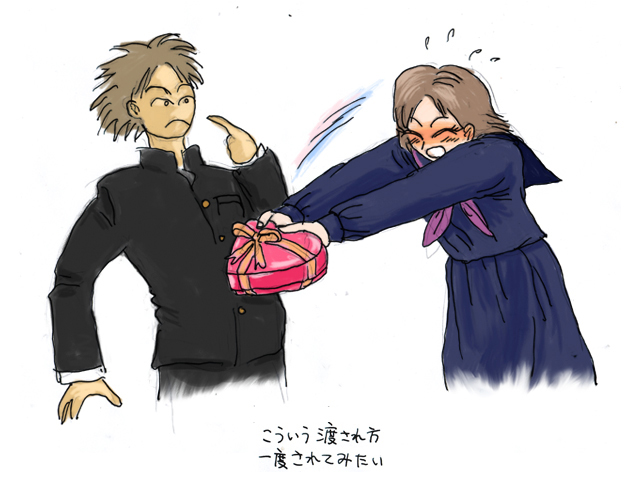
Valentine's Day in Korea has since become a true Hallmark Holiday (Definition: A “Hallmark holiday" is a disparaging term, used to describe a holiday that is perceived to exist primarily for commercial purposes, rather than to commemorate a traditionally significant religious or secular event). Although cards don’t traditionally see a spike in sales, and neither do flowers. Chocolate, instead reigns supreme. So rather than Hallmark Holiday, I’m dubbing the phenomenon a Hershey Holiday. As interesting as a shift from cards, to chocolate is, it’s not why I’m interested in Valentines this year. As I mentioned above, it was marketing, and due to an ‘unfortunate translation and marketing error’, Japanese (and Korean) women thought they were the ones to buy chocolate for men.

Decades later Valentine’s Day in Korea remains an antonym to the western Celebration. I think it’s fascinating that on the Hershey Holiday, Corwin will face social pressure to buy me chocolate instead of the other way around.

Truthfully, I don't really care if she does get me chocolate; I've never actually liked Valentine’s Day, I hate the obligation that I never agreed to, and therefore love the marketing blunder that put the shoe on the other foot. The Japanese have a fascinating history with the holiday sprouting around the giving of obligatory chocolate, women giving chocolate to co-workers, and not just loved ones. That concept doesn't seem to have migrated as well as the foundation for the holiday in Korea. But another Japanese holiday, which did migrate, was created from the ashes of obligatory chocolate.

White day, or Reply Day, is a day of retribution started in 1980s by the National Confection Industry in Japan. On White Day men are expected to return the favour to the women who gave them chocolate on Valentine’s Day. The name, White Day, sprouts from the colour of the chocolate given on this Hershey Holiday. However, Chocolate is not the largest seller on this holiday, instead the main seller is non chocolate candy, such as Scotch Mints. I will thus change the Hershey Holiday term to Scotch Mint Holiday, all whilst keeping the definition of Hallmark Holiday.

For those of you that are single, and love to have your 'anti' valentine's day parties. I have good and bad news for you. First off, the good news, you get your own day! The bad news is that you have to wait until April 14th to get it. The Korean equivalent of an anti valentines celebration is aptly called 'black day'. If you did not receive chocolate on Valentine's Day, candy on White Day, or give for either occasion. Then the Black Day custom is to flock to Chinese restaurants and eat 자장면 (jajangmyeon), or black noodles. This is a holiday invented by the Koreans, not the Japanese, and is therefore mostly celebrated on this peninsula.


With three months in a row all celebrating the 14th of the month, I started to wonder if something was up. That it couldn't purely be coincidence? Could it? Intrigue led me to Google, and Google led me to the official Tourism Korea website. A subsection of the website listed the “Fun & Romantic Holidays in Korea”, according to this article the 14th of every month has a different celebration. At first I was shocked, but for a culture in which couples buy matching clothing, I concluded that it this was not really that out of place.

Most of the days are pretty self explanatory and the website (link) gives a short blurb on each (although no indication about the origin of these days). I'm just going to mention a couple of standouts, at least from my perspective!
January 14th: Calendar Day, Couples exchange planners and calendars and mark important events on them. I was unaware of this when this day slipped by. I'm left without a calendar and I always forget when mother's/father's day is.

June 14th: Kiss Day, kiss everyone you meet. I propose a swap in purpose with December 14ths Hug Day.

August 14th: Green Day, Couples seek nature and relax, yet this is during rainy season, so make sure you bring an umbrella. Singles drink soju to drown their loneliness. You might wonder, ‘why do singles drink soju on green day?’ The answer is easy, although not obvious to those not familiar with soju, soju bottles are all tinted green. It doesn’t really matter what brand or whether it’s plastic, glass or tetrapack, all the packages are green.

December 14th: Hug Day, this is the day where you hug your partner to chase away the cold. I think this holiday and June 14ths Kiss Day should be swapped. It should be hug everyone you meet, not kiss them, and kiss your partner to chase away the cold instead of simply hugging them. Although it turns December into a make out holiday, I think it would be much more socially acceptable to walk around hugging people than it would be going around kissing them. This is also besides the fact that some Koreans wear masks, to cover their mouths to prevent the spread of germs, so kiss access can be limited.

January 18, 2011

same same... just Korea (pt vi)

Korean egg timers start at one...

In western society you reach your first birthday exactly one year after you slid out of the birth canal. You subsequently celebrate that anniversary every year, until the year there is no air in your lungs to blow out the candles (i.e. you're dead).

In Korea you reach your first birthday exactly as you slide out of the birth canal. If a baby is born, it is considered a year old in this country. It doesn't take a math genius to figure out that they were only conceived around nine months prior however, this doesn't seem to matter. The anniversary of this birth is kind of celebrated in Korea, but another candle is not added to the cake to mark the occasion. Candles are only added on New Year's Day, the same day that everyone in Korea ages another year.

For example, one of my students, Kate, now has a baby brother. He was born on December 22nd, and at the second he was born, he should have been given a candle to blow out as he was one year old. ten days later, he should have recieved another cake (this time with two candles) as the calendar flipped and we entered 2011. Kate's baby brother is now 2 years old, and hasn't been sucking air for even a month.

Your humble narrator (author, whatever) is currently 27 years old by Korean standards. I assure you that being called 25 has never sounded so good! Also, in case you were wondering, the western age system is used when it comes to all official government/legal matters, drinking and tobacco use. Yet when dealing with small children, age is important, and they always want to appear to be older. Most of us practiced this with our 1/4, 1/2, 3/4 ages (I'm not 25, I'm 25 3/4).

Are you old enough to be my friend?

Now that I have explained the Korean age system you can understand the second part of this post. This is something that has only recently been revealed to me, although it's been in front of me the entire time. In Korea you can only be 'friends' with people the same age as yourself.

Haha, I just made that sound confusing, yet it is simply a language translation problem. The Korean word for 'friend' is 친구 (chingu), and it is the word often translated with the english word 'friend'. In the Korean language though, a 친구 (chingu) can only be a person with the same age.

Now, refer back to the segment above, everyone ages at the same time. So figuring out who can be your friend is a lot easier as it is based on birth year, not birthday. Anyone born in 1985 would share my age of 27, therefore I could be a 친구 (chingu) with anyone born in that year. This concept works really well with school children, because how often are children of different ages interacting? Classrooms are also usually arranged by birth year (even in western societies). Therefore most of my childhood friends share my birth year, and I can call친구 (chingu).
Callie can't believe she isn't my 친구.
You start to encounter some issues with this system when you grow older. For example my friend, Callie (left), she is older than me in Korean years (and American ones). Since she is older than me, I can't correctly call her 친구 (chingu). I have to use another word, and refer to her as my older sister. It sounds strange, I know, because she is not my older sister, she is my friend. But that is just the way it works here. This is applicable on all fronts, and not just older sisters/brothers. If your friend is younger than yourself you would call them younger brother/sister.

Basically the western word 'friend' isn't universally translated in Korea, instead of being one word, it is many. The Korean language is very structured and places a high importance on status. This leads me to the fact that I have never really noticed this before. I stumbled upon it when my physiotherapist, whom I'd never met before that session, called me his friend upon finding out my age. I was a tad confused and thought he was a little presumptuous. I also had a student tell me about a weekend with his 4 older brothers. Yet, I knew that he only had a younger sister. Short inquiries into both situations enlightened me, and led to my understanding (hopefully) explained above.
I've since spotted another example of this in class. 
(the book asked for the students to talk with their friends about school)
Lucy: Sean Teacher (whine) I don't have any friends in the class. 
Charlie: She doesn't!
Olivia: Lucy is 11, we are 12... We aren't friends. 
(pause)
Sean Teacher: That's okay Lucy, pretend you are 12.

January 10, 2011

same same... just korea (pt. v)

Dental Discovery...

I had a killer toothache one night, so bad that it kept me awake for several hours. I was convinced that I had a cavity in one of my back right molars. I was so sure of it that I could actually see tooth decay, and I started to fret about the cost of getting it filled. A Google search revealed some interesting information. In Korea they still utilize the amalgam filling (i.e. the silver ones with mercury in them). The amalgam filling is quite cheaper than the composite resin filling that is most common in NA. The silver filling, probably due to cost, is entirely covered by national health in Korea, while the composite resin is not. This could be a reason that a lot of Koreans have amalgam fillings. If you walk around Seoul and admire some smiles, you are bound to see a glimmer of silver in someone's mouth.

Actual x-ray of my mouth, taken 12/01/2010
This new knowledge made me fear my dental visit even more. I did not want an amalgam filling, my reason was entirely based on vanity. I honestly don't really care about the slight possibility of mercury poisoning. I only cared about looks, I have spent so much money attempting to make my teeth look normal, an amalgam filling would surely ruin that. If the composite resin (white) filling had mercury I would write a blog justifying why I risked mercury poisoning. In the end I did not have a cavity, and I didn't have to worry about cavities (a subsequent cleaning also revealed that I have no cavities, yay!) I had a piece of food lodged between my gum and my tooth.

That wasn't before I found another interesting difference between North American dentists and Korean ones. Once in the dental chair, I encountered an interesting sight. An x-ray of my full mouth was there waiting for me on an LCD screen. I knew it was mine, because of the steel rod anchoring one of my front teeth to my skull. As I was admiring my jaw line, and looking for the remote (to change the channel) the assistant started to lean the chair back. Right around the time she would usually pull out the 'cool' stylish shades, the assistant raised a medium sized towel. This sheet was roughly the size of a tea towel, and it had an oval hole in the center. Yes, instead of being unfashionable in the dentist chair, in Korea you are hidden behind a smock coloured curtain. The oval opening was placed over my mouth, a small slit allowed the contraption to sit snugly on my nose, my eyes were draped in darkness. 

I found it to be quite uncomfortable underneath the sheet. It was awkward, and unexpected. Due to the fact I was behind a sheet, the LCD screen didn't second as a television. The only visual was darkness, and the only audio was the roar of the drill as the dentist ploughed into my gums.

January 05, 2011

the war on christmas: the eastern front...

Every year in North America it seems that Christmas takes another blow. Some religious organization, or atheist movement takes offence to something related to Christmas. One such example, the infamous shift from 'Merry Christmas' to 'Happy Holidays'. This year the Colbert Report informed me about the FOX news  segment  'The War on Christmas', and I thought I'd add my own entry about Korea. 
Christmas in Korea is really not that big of a deal, it's more of a non event. The holiday is more a reflection of a commercial holiday than a religious celebration. I have not spotted a single nativity scene anywhere, although there are random reindeer, and decorated Christmas trees scattered throughout the neighbourhood. One of the pizza parlours I frequent is the proud home of one such reindeer. He proudly showed off the reindeer on my last visit.

I scouted out to find Santa, or well a physical incarnation of the man in red. Like the nativity scenes he was nowhere to be found, alive that is. Gangnam (a trendy affluent area of Seoul), did have several plastic versions tied to streetlamps, and before you ask, no none of them were Korean. A year ago I was building Pepsi displays honouring jolly old Saint Nick, and this year I can't even find a Coke bottle with his likeness.

The Christmas hangover that is usually associated with the days following Christmas, didn't occur. It seemed like the country was ramping up for New Years, instead of winding down from an overdose of Eggnog (a virtually nonexistent novelty). Pretty much this country boasts an absence of Christmas. Sure it is a holiday, but it is a holiday celebrated much less than many others. Christmas day in Korea was a day like any other, I didn't notice even a single store closure. New Years appeared to have more of an effect on the nation, as there were a handful of shops that didn't open. Since drinking is a national past time in Korea, that seemed to make sense.

Although Christianity is the prominent religion in Korea at 26.3%. That doesn't mean much when almost half of the country is non religious (49.7%). So perhaps there was a war at some point in Korean history that wiped the yuletide spirit from the nation. At the very least though, I think the numbers can help allow you to draw your own conclusion.

Religion or not, I'd say that my biggest loss came in the bakery department. I for one love Christmas baking. I love the excuse for people to make delectable cookies, and other baked goods. I spent Christmas day drooling on Skype, as my parents showed off the loot they sat in front of at a friend's house: Nanaimo bars, brownies, and sugar cookies were all waiting to be eaten, 8,500km away.

I was however able to find and enjoy some premium baked goods in Korea, It simply required a Google search, and clever timing. I suppose that is the best benefit from living in a city of 20 million plus, there is a niche market for everything. Yet when Christmas becomes a niche market you know that you are a long way from home.

September 30, 2010

same same... just korea (IV)

I’d like to explain a part of my absence from the blogging scene. Last week was Chuseok. Chuseok is a three day festival that the Koreans celebrate on the 15th day of the 8th month according to the lunar calendar. This year those days happened to fall in the middle of last week September 21-23. I spent my Chuseok holiday in Sokcho and Samchuk. I am planning on writing a short blab about those places in an upcoming blog.

For now however I’m gonna delve into some Same Same. Chuseok is a major Korean holiday. It is a festival celebrating the end of the harvest. Does that sound familiar? For any Canadians reading October 9th is basically the same holiday, for any yanks the date is November 22nd.

I found it pretty interesting that the Koreans celebrate a similar holiday as we do. Well at least they historically celebrate a similar holiday. Yes they celebrate Christmas and New Years, although they aren’t rooted into history. Christmas is a major commercial holiday (surprise!), and the Koreans seem to prefer to celebrate Lunar New Years over our calendar New Years.

I’ve spent my entire life on the N/A continent and I’ve always been under the impression that thanksgiving is a truly North American phenom. For some reason I was ignorant in this belief, I’m sure you could blame a lot of things for this misguided truth; I’d like to blame TV. I literally just thought Chuseok was only described as a thanksgiving type holiday because it was in the fall. I was shocked to discover the roots of Chuseok, both Thanksgiving and Chuseok are worship holidays (I think I just find anything religion related kind of shocking). The objects of worship are obviously different, but both cultures decided to worship their deity after the harvest. In N/A families usually all gather together and give thanks, in Korea families also all gather and are thankfull for the harvest. Although the Koreans go one step further, Koreans visit their ancestor’s gravesites and make them tidy.

Food is also an important element of the celebration, although both serve different animals. Most Koreans have never seen a turkey, let alone eaten it. I have a couple students that dream of tasting the giant bird, and I told them the many splendors. Koreans don’t have one animal over any other that they serve; I’d assume their tables are covered with a million side dishes (like most meals).

The special item for Korean feasts is a little honey and seed filled rice cake. A Korean rice cake is not the dried up Frisbee you are probably thinking of, a Korean rice cake is a little moist dumpling. I’m not the biggest fan of them; I find them quite doughy and tasteless despite the honey and seeds. I would much prefer to look at the dumplings that I would eat them. They are highly moldable, and come in all sorts of shapes. Traditionally they are crescent moon shaped, but things change, Turducken is hardly tradition yet it caught for ‘trendy’ southerners (I don’t know if you could ever call whoever came up with Turducken trendy, but what the hey).

I didn’t really use the holiday for its specified purpose, I used the time to act like a tourist. I arrived in Seoul on the actual Chuseok holiday (September 22) and it appeared that most of the city wasn’t celebrating or playing tourist, it was business as usual. For some reason I found this to be a comforting thought, perhaps I was happy that people weren’t celebrating with their families, I couldn’t.

July 05, 2010

same same... just korea (III)

The last same same was all about relationships, and how Koreans like to demonstrate their love and affection. Well this time I will explore some myths the Koreans have revolving around death. Okay it's not going to be that deep, just fans and red means you're dead.

Myth #1 Writing your name in red, means you're dead.

While this seems interesting, and easily laughable, Koreans will not write their names down in red ink. I only have experience with my kids, and well they hate it, if I write a name on the board in red they freak out. They rather love it when I write my name down in red. They laugh and point, 'teacher is die'. They also practice this chant with whomever's name I write on the board. Writing your name, or any name for that matter, in red means that they are dead, OR that you want them to die.

I did some quick research and found out that it stems all the way back to antiquity, when red was the colour used to write the names of the deceased on tombstones, and town plaques. I wasn't able to find out any info on why writing in red means you want them to die, but oh well.. Either or, I don't get it, I really don't. Red is just a colour, although colours have huge connotations (ie pink for girls, blue for boys) and I figure it's a debate I'm bound to lose.

I should simply attempt to cash in on the belief. I should inform my kids that the red stigma also applies to candy, especially red M&M's, and that all red candy on down! (why shouldn't red candy get the price is right treatment? Smarties treats the red ones differently.. wait.. I wonder if Smarties are in on this conspiracy theory) Interestingly enough a huge tourist keepsake from Korea is a stamp of your name written in Korean. Well guess what colour ink pad they hand out with this stamp is? you got it RED. There are stories in Chinese culture that only the emperor could use red ink, perhaps that's why the stamps are divvied out with red pads. The conspiracy theorist in me would like to believe it's a covert operation run by Asian governments to eliminate travelers. Most likely the vendor just gets a laugh as he sees weiguks gleefully run away stamping their names in red.

Myth #2 Sleeping with a fan on, means you'll get your dead on.

I briefly heard about fan death just after I arrived in Korea. However using a fan at sub zero temperatures doesn't make sense, and was put aside due to irrelevance. Since the weather has started to cause perpetual sweating, fan chat has blown its way back into conversation, this time for good reason. Fan Death is about as simple as it sounds, well the idea is straight forward anyway. If you sleep while you leave a fan on, you will die, cease to exist, or meet your maker. That is pretty straightforward and is genuinely accepted amongst Koreans. That is the only part of the myth that most Koreans can agree on, what they can't agree on is why. They simply believe that you will expire. Now this seems to be TOTALLY outrages, and I assure you that I feel the same, it's crazy. Yet Koreans freak out similarly to writing their name in red. This is a country that believes this phenomenon.

Fans in Korea are sold with timers on them. It is considered a main selling feature. I'd have to believe that if there was a batch of fans whose timers failed, you'd have a hundred or so Korean families left feeding flies.

My kids and I worked on some riddles the other day and an interesting one came up. 'a man committed suicide in a room by hanging himself. Another man came into the room and found him in the hanging in the middle of an empty room. There was a puddle underneath the man, and he was hanging a metre off the ground' The solution: He was standing on a block of ice. They could do a Korean version of the same riddle, any Korean would understand the riddle, and any foriegner would be truly puzzled. Let's use the same situation 'A man commits suicide in a room, there is nothing in the room besides a 6 speed oscillating fan, that was running as another man entered the room. The deceased is curled in fetal position in the middle of the floor. The fan is against a wall. The man does not have any cuts on his entire body, how did he die?' solution: the man used the fan to kill himself, but how? what did the fan do?

There are several streams of thought on the issue, Wikipedia even has a great page attempting to explain several of them (please..please...please read the article). My personal favourite: that the fan blades chop up the oxygen molecules leaving you none to breath. Other explanations: the fans create a vortex and steal all the oxygen in the room causing you to asphyxiate. The most plausible cause of fan death, is that the fan will suck the moisture out of your body, It will also lower your body temperature enough to induce hypothermia, causing death. This explanation has even garnered support from the Korean Government advising people NOT to sleep with fans, because of fear of hypothermia. The country is obsessed with this myth, yet again I find myself entering into an unwinnable debate.

Yet again, I really don't get it.. I honestly don't get either Myth. Yet they are perfect examples that you believe what you are taught. At a young age all my kids have been repeatedly told about these two myths. It's almost beaten into their subconscious. When my kids see me write names with that red pen they FREAK out, they cringe, their body's physically repel. I've talked to some of my kids about fans and their reaction is similar, in all ways shapes and forms. It is said that the pen is mightier than the sword. I can accept that, although I thought they were talking about diplomacy, I guess not. It is said that fans can steal our precious bodily fluids. I can't accept that, I thought it was the communists that wanted to steal them (Dr. Strangelove reference), I guess not, I'm just confused...

June 16, 2010

same same... just korea (II)

This is a coupled out edition of same same.. My second addition to the random things koreans do that are different from life in NA.

There are two standard questions Korean kids ask their teachers. First their age (I actually do the math and make it my Korean age). Secondly they ask if you are married. Most weigook teachers are single. This creates a problem for the children. You see, Koreans are entrenched with this idea that you are supposed to be married pretty much… well right outta high school, idk, that’s supposed to be code for super young. There is SO much pressure on the young people of Korea to get married, and pop out children, or child as the recent birth rates are showing. The desire to be an ajuma (older married woman) or ajashi (older married man) is ginormous. My kids look at me strangely because I’m not married.

My few words on the subject don’t reflect the importance of this issue for Koreans. However due to space limitations, and that this topic is not solely about coupling in korea, I’ll move on. The easiest way to demonstrate that you are a couple is easy. PDA’s, a nice make out session in public, groping, idk there are many ways to show your affection for others. However, PDA’s are a faux pas in this country. How do you overcome this dilemma? What can a Korean couple do to show they are together without a public make out session? They do a couple things.

First, they match, they dress in identical clothing. Matching shirts, matching pants, I’m sure the underwear matches as well. In fact i’d bet on it, cause some store windows have mannequins in matching underwear. There has to be an entire industry here that specializes in creating his and her clothing. When I say exact I mean exact replica clothing one male fit, and one female fit. Although a rebuttal can be made, neither male nor female Koreans have much shape, but someone’s making a killing.

Secondly, what is a good honest replacement for madly making out in public? Easy! Madly photograph each other in public. If you can’t stick your tongue down her throat because of cultural norms, stick your camera lens down there. I’ve had the ‘opportunity’ to witness this a couple times (NO, not a guy literally shoving a camera lens down a girls throat). Couples here are enamored with each other, and both use every medium (especially camera’s) they can grab to fully document everything. It’s like sugar never tasted so good. Despite being able to start up a modeling portfolio these couples are able to demonstrate to the world, or Seoul, that they are together.

If you come to Korea and meet the most amazing Korean ever, and you need to figure out if she (or he) is taken. Look for another person dressed in matched clothing, OR a single member of the Korean paparazzi tagging behind your intended target. If you find one, or both of these things. I'm sorry they are taken, but don't worry there are a shit ton of koreans, and individuality isn't that common here. You're sure to find a replica somewhere.

March 27, 2010

same same... just Korea (I)

Every culture does things that make you shake your head.. Korea is no different.. i'd consider this part one?

an umbrella.. a great device.. great for repelling rain.. koreans also use umbrella's when it is snowing.. it makes sense.. both are water, just in different form.. a melted snowflake looks the same on clothes as a drop of water.. yet i still think something is odd..

Masks.. we all know that masks are a pretty interesting part of asian culture.. the japanese have kabuki masks.. and the korean's have a wooden mask similar, except the mouth can move.. ANYWHO.. not talking about festive masks.. the pollution in this city is pretty bad.. and during yellow dust season its worse.. so the korean's wear masks covering their nose and mouth.. very similar to surgeon masks.. It makes walking around quite interesting.. i mean there are all these people in masks.. it makes sense.. i just feel so awkward, what do they know that i don't.. (fact: living in cities with poor air quality can take 9 years off your life expectancy...i'm wondering how long you have to live there..). ALSO the masks come in different colours, and designs.. i've been told i'm getting the 'cooter boy' mask for my birthday... i would have liked spongebob.. but i'll take it..

Garbages.. The streets in seoul are some of the cleanest i've ever seen in a major city.. litter doesn't crowd them like some cities i've been too.. although this intrigues me.. because most cities where garbage is a problem have waste bins on every street corner.. or at least within eyesight.. Seoul on the other hand, does not.. there are very VERY few trash cans in seoul.. i think it has something to do with their insane garbage programs or something (i have yet to figure out the justification)...there are only a few garbage cans..if you have garbage, you will probably partially decompose while you try to find a garbage can.. i basically walk with it all day till i get home (my clothes smell awesome.. okay lie.. but yeah.. walk with your daily trash.. not cool).. It's crazy, you'd think the streets would be littered (haha) with little piles of trash, instead they are covered in asian saliva.. apparently the koreans chew up their wrappers and spit them all over the ground i don't know.. but there is spit everywhere and not much garbage..

Costco.. The great american retailer.. well its not Wal-Mart.. but whatevs.. I went to a costco here a couple weeks ago.. very similar experience to what i would get back home.. The costco pizza.. mmm.. it was everything i wanted and more.. but the real reason for this little blurb.. the korean's love sidedishes. Kimchi accompanies every meal, as well as a myriad of other small plates.. Well costco pizza doesn't come with kimchi.. so what does a sidedish oriented culture do? They create one!!!... its a beautiful mix of onions, a little bit of relish all swimming in a sea of mustard.. if you blew up a french's mustard bottle.. thats what it might look like..

So thats all for now... there will be more, i'm sure......